What Is a 4-Point Inspection?
A 4-point inspection is a focused look at four specific systems in a home — the roof, electrical, plumbing, and HVAC. In Florida, insurance companies require it on certain homes (most often based on the home’s age) to decide whether those systems are in acceptable shape to cover. It is not a general home inspection. It is a targeted, insurance-driven assessment that records the age, type, condition, and material of each of the four systems, documents them with photographs, and hands that information to your insurer as part of underwriting.

If you own a home in Florida and someone has asked you for a 4-point inspection, it’s because your insurer wants to size up the risk before it issues or renews your policy. The inspection exists for their benefit. It tells them whether the four systems most likely to trigger an expensive claim are sound, or whether there’s something present they’d rather not insure. That’s the entire purpose — it answers the insurance company’s questions about four systems, and nothing more. In Lee County, roughly 73% of all housing units are more than 20 years old, which means they’d need a 4-point inspection when the owner shops around or switches carriers — about three out of every four homes across Cape Coral, Fort Myers, North Fort Myers, and the surrounding communities. That figure holds fairly steady across the rest of Southwest Florida, including Collier and Charlotte Counties.
Who Can Perform the Inspection
The inspection has to be completed, signed, and dated by a verifiable Florida-licensed professional. Citizens and most private carriers will accept it from a licensed home inspector, a general, residential, or building contractor, a building code inspector, a registered architect, a professional engineer, or a building code official the State of Florida has authorized to verify building code compliance. A trade-specific license — an electrician or a plumber, for example — only qualifies that person to sign off on the section of the form that falls inside their trade.
What This Inspection Is Not
A 4-point inspection is not a home inspection. A full home inspection covers the entire property — structure, foundation, interior, exterior, windows, doors, insulation, ventilation, appliances, and a great deal more. It’s usually done for the buyer during a real estate purchase, to give them a full picture of the home’s condition.
A 4-point does none of that. It answers four narrow questions for the insurer and stops there. It doesn’t look at anything beyond those four systems, it doesn’t grade the overall condition of the home, and it isn’t performed for the homeowner’s benefit — even though what it turns up can absolutely be useful to you. If it flags a Federal Pacific panel in your garage or polybutylene supply lines in your walls, that’s now something you know about, whatever the insurance company decides to do with it.
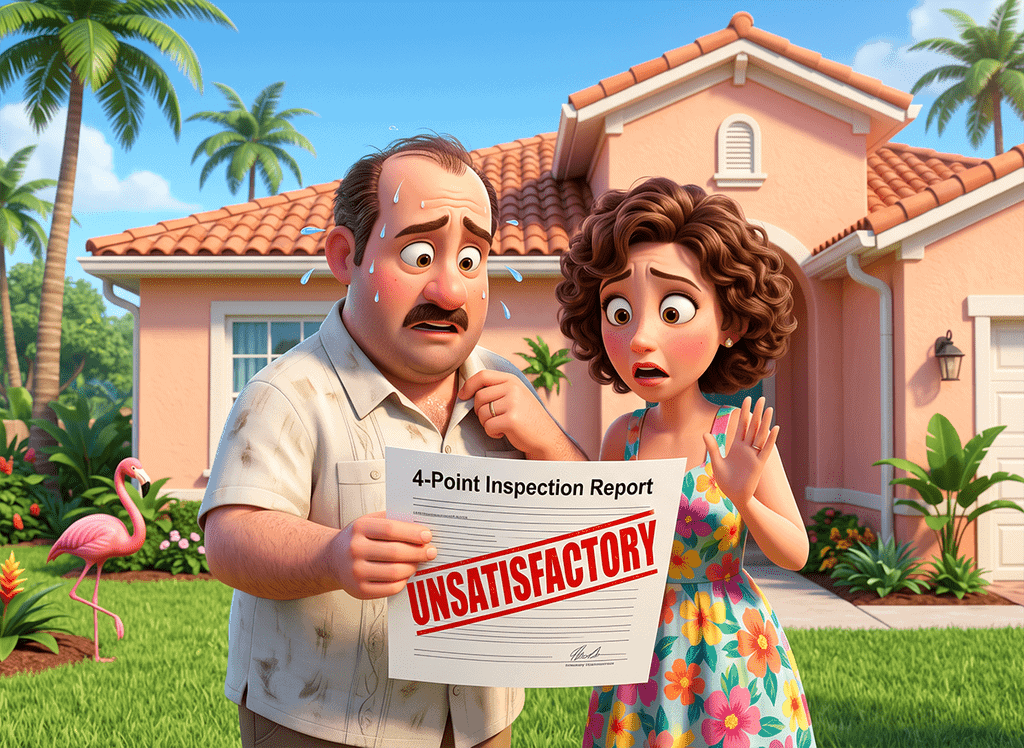
A wind mitigation inspection isn’t pass-or-fail; a 4-point inspection is. Every item is marked either Satisfactory or Unsatisfactory. If even one comes back Unsatisfactory, carriers will want a passing report before they’ll write the policy. A few conditions are outright deal-breakers for most companies — Federal Pacific panels, polybutylene piping, a roof with no useful life left.
Others might be accepted with an endorsement, a higher premium, or a requirement to fix the problem within a set window, though that’s not the norm. Since Hurricane Ian, carriers have only gotten stricter. By boxing yourself into the small group of companies willing to make exceptions, you may be passing up a better rate somewhere else. (I’m not an insurance agent, so take that as my opinion, not advice). Plenty of homes — newer builds especially, or well-kept homes whose systems have been updated over the years — clear the process with no problems at all. If you’d like the deeper background on how each feature of the form is evaluated, this whole site is built for exactly that.
Need a 4-Point Inspection? Find Out What a Four Point Inspection Will Cost for Your Home in Under 10 Minutes!
(If you’re also weighing a wind mitigation inspection, the companion site wind-mitigation.info covers that side in the same depth.)
- Who Needs One and When?
- What a 4-Point Inspection Covers
- The Difference Between a 4-Point & Wind Mitigation Inspection (& Your Roof)
- Finding the Right Inspector
- Preparing for Your 4-Point Inspection
- The Day of the Inspection
- Understanding the 4-Point Inspection Form (+ Detailed Breakdown of Each Section)
- Your Report Failed, Now What?
- How the 4-Point Inspection Came to Exist
- The Relationship Between the 4-Point Inspection & Your Roof
A Note About This Site This site is focused specifically on 4-point inspections as they apply to homes in Southwest Florida. Primarily the Cape Coral, Fort Myers, Bonita Springs, Naples, Punta Gorda, and surrounding Lee and Collier County areas. This is the region we know best, and the examples, photos, and references throughout this site will reflect that.
Florida is a large and geographically diverse state. While the 4-point inspection process and form are used statewide, some construction types, building code requirements, insurance carrier preferences, and regional considerations can vary depending on where you live. If you are outside of the Southwest Florida area, the general information here will still be useful, but there may be differences that apply to your specific region that are not covered on this site.
Cheap 4-Point Inspection? – Read why it may not be worth the minor savings.